
Climate
41 million tons of CO₂ impact, combining 36.4M tCO₂e in avoided emissions and 4.5M tCO₂e in removals through wetland and restoration.

The PLUM Project (Peat and Mangrove Conservation and Restoration Project) delivers significant climate benefits through the protection and restoration of critical peatland and mangrove ecosystems in Central Kalimantan, Indonesia. These ecosystems are among the most carbon-rich landscapes in the world, playing a vital role in both reducing greenhouse gas emissions and removing carbon dioxide from the atmosphere.

Central Kalimantan, Indonesia
.png)
Climate
42 million tons of CO₂ impact, combining 37.5M tCO₂e in avoided emissions and 4.5M tCO₂e in removals through reforestation and wetland restoration.


.png)
Community
Improving lives in 13 villages through local job creation, clean water, mobile health clinics, educational support, and income generation for thousands of community members.


.png)
Biodiversity
Habitat for 365+ species, including 31 IUCN Red List species with 23,665 ha now better managed for conservation.


Climate Impacts
Crediting period :
2022 to 2082 (60 years)
Avoided emissions :
36.4 million tCO₂e
Carbon removals :
4.5 million tCO₂e

Over its 60-year crediting period, the PLUM Project is expected to generate an estimated 41 million tonnes of CO₂ equivalent (tCO₂e) in climate benefits. This includes:
This translates to an average of over 680,000 tCO₂e per year, demonstrating the project’s substantial contribution to global climate mitigation efforts.

Impacts
Driving measurable impact through carbon reduction, ecosystem restoration, and stronger, healthier communities.

Over the life of the project :
-
Avoids 37.5 million tons of carbon emissions.
-
Removes 4.5 million tons of carbon from the atmosphere.

Over 2,000 community members will be gaining new skills and are expected to experience better livelihoods over the project period.

Measurable improvements in health services for 12,000 people.

Enhanced education access for 2,200 students.

PLUM carbon credits will be generated across 3 types:
-
Wetland Restoration & Conservation (WRC)
-
Afforestation, Reforestation & Revegetation (ARR)
-
Avoided Planned Deforestation (APD)

More than 67 annual local job creations.

Better water quality for more than 14,000 people.

In total, over the life of the project, 16,500 people will see measurable improvements in well-being.
Before, our toilet was by the river, and we often felt scared and uncomfortable, especially at night. Now, having it inside makes us feel much safer and more at ease.
Tuti Handayani
Toilet Beneficiaries

We are very grateful for PT PUM’s support. This opportunity has inspired us to start a business that can empower the women and mothers in our PKK group, providing additional income to support their families and helping our village move forward together.
The Women's Group (PKK)
Local Snack Production

So the background to collaboration with PT PUM is from an awareness that education cannot be developed alone only by schools. It needs collaboration with the government, it needs collaboration with the community and PUM is part of society that has special of concern for the environment.
Saiful Rohman
Head of Junior High School 3, Katingan Kuala

Voices from Our Community

PLUM Project activities (RWE, ARR, REDD+)
Project Philosophy

✤ Protect and restore peatland and mangrove ecosystems as natural climate solutions
✤ Prevent deforestation and peat degradation to reduce long-term carbon emissions
✤ Rewet degraded peatlands to restore natural ecological balance
✤ Use restoration and conservation together to build climate resilience
✤ Work with nature’s processes to create sustainable climate solutions
Project Activities


Fire Patrol and Watchtowers
In the dry season, when the risk of fire increases, these observation points become critical. A thin line of smoke, barely visible in the distance, can mean the difference between containment and catastrophe.
On the ground, patrol teams move through the forest. They follow familiar routes by checking, observing, listening.
Fire prevention is not a single action, but a constant presence.
Above and beyond what the eye can see, Automated Weather Stations quietly collect data: rainfall, humidity, temperature. These signals help anticipate risk before it materializes, guiding decisions in real time.
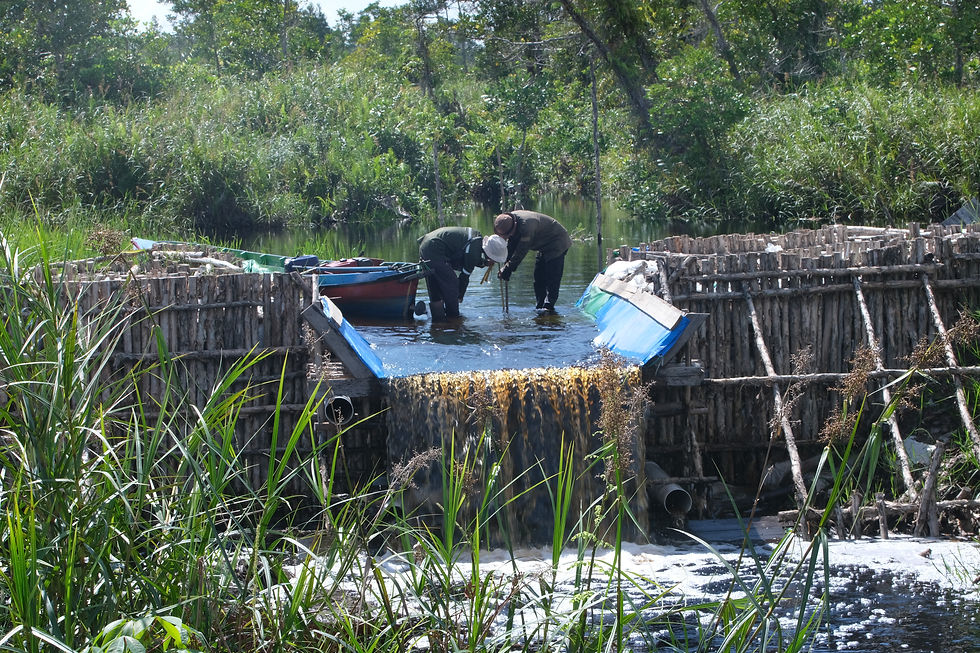
Canal Blocks
PLUM restores what was once disrupted. Canals that once drained the land are carefully blocked. Water returns, slowly saturating the soil again. The peat begins to heal.
It is not an instant transformation. It takes time. But with each passing season, the land regains its natural balance. And with it, its ability to store carbon safely.


Nursery and Replanting
Our nurseries are the foundation of large-scale restoration.
PLUM grows native peatland and mangrove species, making sure each seedling fits well in its natural environment. This increases survival rates and supports long-term forest recovery.
Through this approach, restoration is not one-off. It is continuous, scalable, and rooted in ecological integrity.
Guarding the Mangrove Edge
At PLUM, restoration is both patient and deliberate. PLUM teams work along the shoreline, replanting degraded areas and protecting the mangroves that remain. Over time, the forest begins to return. Not just as trees, but as a living system that supports both climate and livelihoods.


